Gasfitter.ca / PRACTICAL GUIDE
Tank vs Tankless Gas Water Heaters: Which Is Right for You?
Gas tank or tankless? Compare efficiency, lifespan, flow, power needs and FortisBC rebates to choose the right water heater for a Lower Mainland home.
 Gasfitter.ca
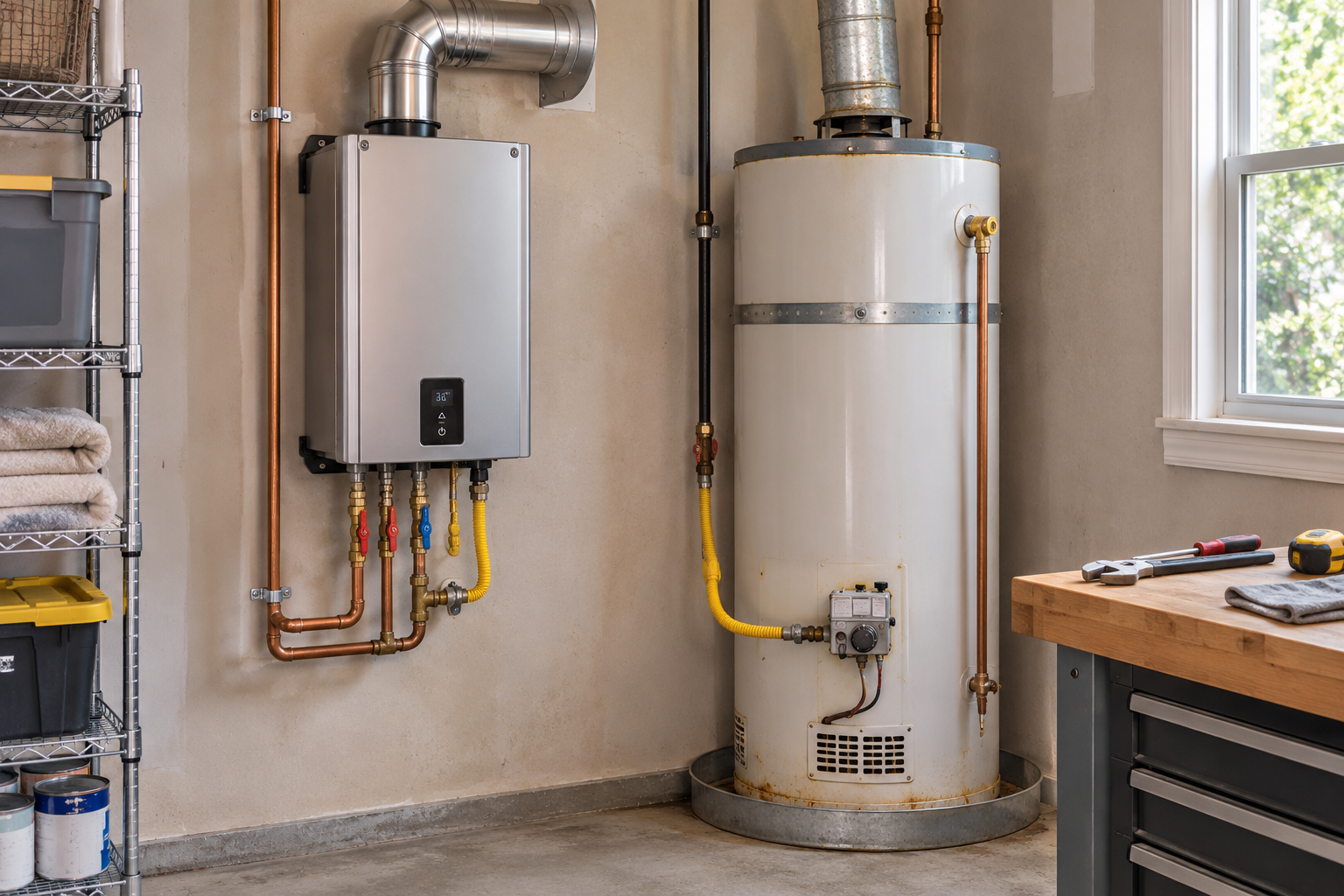
A tankless gas water heater may suit a household seeking lower standby losses and sustained hot-water delivery, provided the selected system can meet the actual demand and the property can support the installation. It cannot supply unlimited simultaneous flow. A storage tank is usually the better choice if you want the lowest installed cost, a simple like-for-like swap, and hot water during a power outage with a standard non-powered model. According to Natural Resources Canada, an ENERGY STAR certified tankless water heater uses about 30% less energy on average than a storage tank model. The right answer depends on your household's hot water use, your gas line and venting, and your budget.
How each type works
Storage tank. A gas burner under the tank keeps a full tank of water hot around the clock. When you open a tap, hot water leaves the top and cold water refills the bottom. Because it keeps heating stored water even when nobody is using it, a tank has standby losses.
Tankless (on-demand). Water is heated only as it flows through a heat exchanger, so there's no stored water to keep hot. There is no tank to deplete, but output is limited: the heater can raise only a certain flow of incoming water to the requested temperature.
Side-by-side comparison
| Gas storage tank | Gas tankless | |
|---|---|---|
| Energy use | Higher, due to standby losses | ENERGY STAR models about 30% less on average (NRCan) |
| Service life | Depends on model, water conditions and maintenance | Depends on model, water conditions and maintenance |
| Hot water supply | Limited by tank size; can run out | Continuous, but limited by flow rate |
| Upfront cost | Lower | Higher unit and installation cost |
| Electricity needed | Many standard models need none | Requires power; FortisBC notes some models won't work in an outage |
| Space | Floor footprint of the tank | Wall-mounted, saves floor space |
| Install complexity | Often a simple replacement | May need a larger gas line, new venting and a condensate drain |
Where tankless makes the most sense
- Households that run short. If back-to-back showers or a big soaker tub drain your tank, a tankless proposal deserves evaluation against the actual simultaneous demand, temperature rise and installation conditions.
- Homes planning to stay put. Compare purchase, installation, maintenance and energy costs over the period you expect to own the equipment. A longer anticipated service life does not guarantee a financial payback.
- Tight utility rooms. Wall mounting frees up the floor space a tank occupies.
- Smaller daily use. Reduced standby losses can matter when demand is intermittent, but actual savings depend on use and the equipment being compared.
Where a tank still makes sense
- Lowest upfront cost. A like-for-like tank swap is usually the cheapest and quickest option.
- Power outages. A standard atmospheric tank with a standing pilot doesn't need electricity. Tankless models generally need power for controls; confirm the exact model documentation.
- Simultaneous heavy demand. A large family running a dishwasher, laundry and two showers at once may exceed a single tankless unit's flow rate, especially in winter.
- Difficult retrofits. Some homes would need a bigger gas supply line or new venting route to support a tankless heater, which adds cost.
The winter factor in the Lower Mainland
Incoming water is colder in winter. For a tank, that means slower recovery. For tankless, it means the unit has to raise the water temperature further, so the maximum flow it can deliver at your set temperature drops. When a contractor sizes a tankless heater, ask them to size it for winter inlet temperatures and your realistic peak use, not the summer case.
Installation requirements
Use an appropriately licensed gas contractor for the replacement and confirm the applicable permit authority before work starts. Confirm the selected contractor is appropriately licensed and that permit responsibilities are included in the agreement. Things your fitter will look at:
- Gas supply. Tankless heaters need significantly more gas input when running than a tank burner, so the existing line and meter may need upgrading.
- Venting. Condensing units vent differently from atmospheric tanks. Your fitter will confirm what's required for the model you choose.
- Condensate drain. Ask how condensate will be handled for the selected condensing equipment.
- Electrical. Tankless units need a power supply for controls and the fan.
- Water quality. Mineral build-up affects tankless heat exchangers, so ask about flushing schedules in your area.
Rebates: check before you buy
Rebates change often. Do not assume that a previous residential or income-qualified offer is still available, or that your household and proposed model qualify. Check FortisBC and Better Homes BC for current offers, and confirm the model is on the eligible list before you sign a quote.
Quick decision checklist
- Do you regularly run out of hot water? Lean tankless, or a larger tank.
- Is your current tank under 10 years old and working fine? You may not need to decide yet.
- Do you lose power often and need hot water when you do? Lean tank.
- Will you be in the home long enough to recover the higher upfront cost? Lean tankless.
- Does your gas line, venting or drain location make tankless expensive to retrofit? Ask for both quotes.
A licensed gas fitter can quote both options for your actual home, including any gas line or venting changes, so you can compare real installed costs rather than sticker prices.
Start with the problem you actually need to solve
Before choosing equipment, separate three complaints that sound similar: the water becomes cold halfway through a shower, the first hot water takes too long to reach a bathroom, and the temperature changes whenever another tap opens. A larger heater might address the first problem but leave the second unchanged. A distribution or control problem can contribute to the third. Describe the symptom, its timing, and which fixtures are operating together before asking for a replacement recommendation.
For example, imagine a household where one evening shower is comfortable but the next person gets lukewarm water. That is different from two showers becoming lukewarm immediately when used together. The first pattern calls for a look at stored supply and recovery; the second calls for evaluation of simultaneous demand and the whole delivery system. These are planning examples, not diagnoses of any particular home. A qualified contractor should establish the cause before equipment is ordered.
Keep a short demand diary for several normal days. Note shower overlaps, bath filling, laundry, guests and any unusual peaks. Avoid guessing at litres per minute from how powerful a shower feels. Fixture information and professional measurements provide better evidence. Tell the contractor about planned changes as well: a basement suite, another bathroom or a future appliance can alter the brief. A replacement chosen only around today's quietest day may disappoint after a renovation.
Compare recovery with flow, rather than comparing tank size alone
Storage equipment is described partly by the amount of water it holds and its ability to restore that supply. Tankless equipment must meet demand as water passes through it. Neither label alone tells you how the household will experience a busy morning. Ask the contractor to explain the proposed equipment using your actual sequence of use, including what happens when an additional fixture opens.
A useful written comparison should identify the exact model, its published performance information, the inlet and delivery temperatures used for the assessment, and any limits on simultaneous use. A marketing maximum flow figure without its temperature-rise condition is incomplete. Do not combine the highest advertised flow number with an unrelated winter assumption. The designer needs one consistent set of conditions when assessing the proposed system.
Nor should a larger burner be treated as a free upgrade. Its stated input becomes one of the demands on the gas service when it operates. Other connected equipment, the route of the piping and actual supply conditions remain relevant. The Gasfitter.ca gas-line planner can help organize entered appliance loads and measured routes for a discussion. It records information and totals; it does not calculate pressure loss, select pipe sizes or approve meter capacity.
A worked planning example without pretending to size the installation
Consider a hypothetical owner comparing a replacement storage heater with a tankless conversion. They record a 12-foot route from a proposed water-heater location to an existing branch connection and another 18-foot section back toward the service entry. Those entered lengths total 30 feet. That total is useful documentation, but it is not a pipe-size calculation, a developed-length certification or proof that the existing branch can supply a new appliance.
The owner should also record the input shown on each existing appliance rating plate, clearly marking unreadable or unavailable values as unknown. If the proposed model has not been selected, its input stays unknown too. Adding invented typical values would make the worksheet look complete while weakening the decision. The contractor can then inspect routing, fittings, pressure, connected demand and utility requirements using the actual installation and applicable methods.
For the hot-water comparison, the owner describes two showers that sometimes overlap, rather than asking for unlimited hot water. The contractor is asked to explain whether each proposal meets that pattern and what compromises remain. The result might support either technology, or identify a separate distribution issue. The value of the exercise is a better question and an auditable brief, not a remote declaration that a conversion will work.
What belongs in an installed-price comparison
Request two quotes with comparable boundaries. Each should identify the appliance, removal and disposal, access work, proposed gas and water connections, venting, electrical work, condensate arrangements where needed, permits, commissioning and making good affected finishes. Ask which items are confirmed and which are allowances pending investigation. A low equipment price can lose its advantage when several necessary tasks sit outside the quote.
For a tankless conversion, ask specifically who is responsible for evaluating the existing gas supply and arranging a utility change if one is required. Ask whether a proposed vent terminal can be installed at the intended location and whether the route remains accessible for maintenance. For a storage replacement, ask whether existing venting and connections have actually been assessed rather than assumed reusable because the old appliance occupied the same space.
Also compare maintenance access. A compact wall-mounted appliance still needs room for servicing, connection access and removal of components. A shelf or cabinet added later can undermine that access. Take photographs of the surrounding space for the quotation visit, but do not dismantle equipment to obtain them. Written scope and a site visit are more useful than choosing a product solely from the apparent size of a cupboard.
Put operating costs into a household budget honestly
Energy efficiency and financial payback are related but different questions. A more efficient heater may use less fuel for the same hot-water service, yet installation differences and maintenance costs affect the household's overall spending. Ask for the assumptions behind any savings estimate: hot-water demand, energy price, comparison appliance and expected maintenance. A precise payback number without those inputs deserves further questions.
Compare several scenarios rather than one confident forecast. A household with little daily hot-water use may value reduced standby losses but have less total fuel expenditure to recover a substantial installation premium. A household with heavy use may have more energy at stake while needing a more demanding performance assessment. Neither situation guarantees that one technology wins financially. Keep comfort, space and maintenance preferences visible alongside the numbers.
Do not treat a possible rebate as money already received. Save the official program terms applicable to the application, verify customer and equipment eligibility, and establish whether approval is required before work starts. Confirm deadlines and the documents the installer will provide. If an incentive is essential to affordability, resolve that uncertainty before signing an agreement rather than relying on an older article or a sales summary.
Maintenance, outages and the handover conversation
Before purchase, ask for the maintenance requirements of the exact model, including water-quality considerations and who can service it locally. Avoid a universal flushing timetable based only on neighbourhood names. Water conditions, usage and the manufacturer's instructions matter. Keep maintenance receipts and note changes in performance so a service technician has more than a vague report that the water seems different.
Power-outage behaviour must also be checked model by model. Some gas storage heaters need electricity for controls or powered venting; tankless controls commonly need power as well. A gas fuel connection alone does not establish that an appliance will operate during an outage. Do not improvise electrical backup or venting changes. Ask what the manufacturer's documentation allows and have any proposed arrangement evaluated by qualified people.
At handover, request the model and serial details, operating manual, warranty information, permit records where applicable and a clear explanation of normal operation. Ask how to recognize a service issue and whom to contact. If gas is smelled or a carbon-monoxide alarm activates, follow emergency directions and leave the affected area rather than using this comparison article for troubleshooting. A good replacement decision ends with a maintainable, documented system, not simply a new box in the utility room.
Frequently asked questions
Does tankless mean unlimited hot-water flow?
No. A tankless heater can provide sustained delivery only within its output at the required temperature rise. Simultaneous fixtures can exceed that output.
Can an existing gas line automatically serve a tankless heater?
No. A qualified contractor must assess the actual model input, connected demand, piping and supply conditions; a planner worksheet does not approve capacity.
Will a gas water heater work during a power outage?
It depends on the exact model and its controls and venting. Verify the manufacturer documentation rather than assuming all gas equipment operates without electricity.
How should I compare tank and tankless quotes?
Compare complete installed scopes including connections, venting, electrical work, drainage where required, permits, commissioning and maintenance access, not just appliance prices.